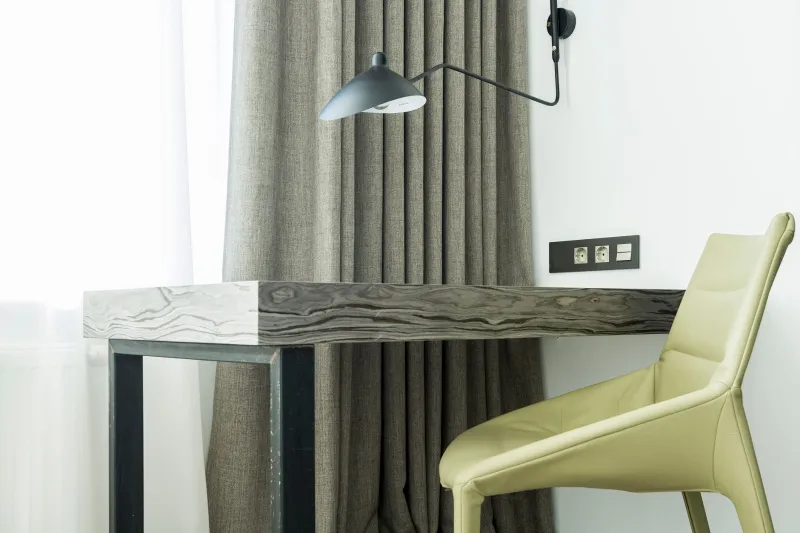
The Movable Wall: Zoning an Open-Plan Sussex Home with Tailored Curtains

Photo: Basher Eyre , CC BY-SA 2.0, via Wikimedia Commons
Open-plan living is often described as generous, and so it is: light travels, conversation carries, and the kitchen no longer feels like a separate country. Yet generosity is not the same as definition. A room that does everything can struggle to say what it is for at any given hour. The usual answer is to build something, but a wall is a permanent argument. Curtains offer a softer proposition. Made-to-measure curtains can mark a threshold, screen a sightline and absorb a little of the noise that hard surfaces send back, while leaving the architecture of the room intact.
Zoning by intention rather than by wall
The first question is not where to hang a curtain but what the curtain is being asked to do. In an open-plan Sussex home, the zones are often already present in behaviour: the table where breakfast happens, the sofa oriented to the garden, the desk tucked beside the window. A curtain can make those behaviours legible. It can separate a dining area from a sitting room without closing either off; it can give a snug the suggestion of enclosure; it can screen a kitchen's working clutter from the view of a guest at the table. The curtain is not a partition in the building sense. It is a movable boundary, drawn when privacy or focus is wanted and stacked away when the room needs to feel whole.
This distinction matters because it changes the specification. A curtain intended to be drawn every evening needs a different weight and track from one that is mostly decorative. A curtain used to screen a sightline must be wide enough to cover the angle, not merely the window. A curtain that marks a threshold should stack clear of the route through it. The zoning is achieved by the curtain's position, its fullness and its habit of use, not by the fabric alone.
The track is the first decision
For zoning, the track is often more important than the fabric. A ceiling-fixed track allows a curtain to run from wall to wall or to turn a corner, defining a plane where no wall exists. It also allows the curtain to hang at full height, which makes the boundary feel architectural rather than provisional. In many open-plan rooms, a recessed track is the most discreet solution: the curtain appears to descend from the ceiling itself, and the fixing disappears. In a renovation, a surface-mounted track can achieve a similar effect if it is specified in a finish that relates to the ceiling or the joinery.
The choice between one continuous track and separate tracks is a practical one. A continuous track can carry two curtains that meet at a central point, creating a soft division that can be opened from either side. Separate tracks allow each zone to operate independently and can be simpler to install where the ceiling structure changes. Either way, the track should be positioned so that the stack-back does not encroach on circulation. A curtain that gathers into a doorway is not a boundary; it is an obstruction.
Ceiling fixings deserve early attention. Plasterboard ceilings require appropriate anchors, and heavy curtains may need additional support or noggins. In period Sussex homes, ceilings can be lath and plaster, and fixings must be chosen with care to avoid cracking or damaging cornice details. Where a recessed track is planned, the ceiling void must be deep enough and the installation sequenced before decoration. These are not reasons to avoid the approach; they are reasons to decide before the first fixing is made.
Fabric weight and the question of permission
Fabric weight determines how convincingly a curtain performs as a boundary. A lightweight linen or voile will filter light and soften a view, but it will not create much sense of separation. For zoning, a medium to heavy fabric is usually more persuasive: wool, heavy linen, velvet or a closely woven cotton, often with an interlining. Interlining adds body, improves the drape and contributes a measure of acoustic softness. It also makes the curtain more effective at blocking light and reducing draughts, which matters in older properties.
There is, however, a case for lightness. In a small open-plan room, a heavy curtain drawn across the middle of the space can feel like a wall that has forgotten its manners. A sheer curtain, or a double-sided curtain with a lighter face towards one zone, can suggest a boundary without imposing one. The question is one of permission: does the curtain allow the two zones to remain aware of each other, or does it insist on separation? Both answers can be right, but they lead to different specifications.
Sightlines, stack-back and the discipline of the edge
A curtain used for zoning is often seen from the side as much as from the front. The edge of the curtain, its leading edge and the way it stacks, becomes part of the room's composition. A generous stack-back, calculated from the fullness of the curtain, keeps the opening clear. A leading edge that is weighted and finished with care will hang consistently, which matters when the curtain is viewed in profile. The hem should clear the floor by a small margin, typically around ten to fifteen millimetres, so that the curtain does not trail or collect dust.
Sightlines are equally important. If the curtain is intended to screen a kitchen from a sitting area, it should be wide enough to cover the diagonal view, not just the straight-on view. If it is intended to soften the transition between a dining table and a sofa, it may not need to close fully at all. A partially drawn curtain can be more effective than a fully closed one, because it suggests a boundary without enforcing it. This is the discipline of the edge: knowing how much curtain is enough.
Acoustic softness and the Sussex context
Open-plan rooms are often acoustically lively. Hard floors, large glazing and smooth ceilings reflect sound, and a room that feels generous can also feel noisy. Curtains are not soundproofing, but they do reduce reverberation. Interlined curtains, particularly those that stack in generous folds, absorb a proportion of the sound that would otherwise bounce around the room. In a Sussex home, where many properties combine older fabric with modern extensions, this can be a welcome benefit. The curtain does not silence the kitchen, but it can take the edge off the clatter.
A considered boundary
The appeal of curtains as zoning tools is that they are reversible. They can be drawn for dinner and opened for the afternoon; they can give a guest a sense of privacy without removing the room's openness. For a Midhurst home, that flexibility is often more valuable than a permanent partition. The work lies in the specification: the track that carries the curtain, the fixing that holds the track, the fabric that gives the boundary its weight and the stack-back that keeps the route clear. Handled with care, a curtain can do what a wall cannot. It can define a space without dividing a household.