The Bathroom Exception: Why Tailored Curtains Deserve a Place in Wet Rooms
The Default That Deserves a Second Look
In Midhurst and across Sussex, bathroom windows are routinely fitted with blinds. The reasoning is understandable: steam, splashes and privacy appear to argue for a wipe-clean surface rather than cloth. Yet the assumption is not a rule, and in many bathrooms — particularly period properties with deep reveals, sash windows or awkwardly placed ensuites — a made-to-measure curtain can be the more considered solution. The key is to specify for the room rather than avoid it.
Moisture Is a Matter of Specification
The first objection is always moisture. Cloth, however, is not a single material; it is a family of materials with very different behaviours. Tightly woven polyester, polyester-cotton blends and washable cottons with a soil-resistant finish will tolerate the humid atmosphere of a bathroom far better than heavy velvet, silk or wool. The aim is not to make the curtain waterproof but to choose a fabric that dries quickly, can be washed, and will not hold condensation against the window. A simple test at sample stage — holding the cloth over a steaming kettle, then allowing it to dry — gives a useful indication of how it will behave.
Loose weaves and brushed surfaces should generally be avoided. They trap moisture and dust, and they are slower to dry. A smooth, closely woven cloth with a modest weight will hang cleanly and recover well after washing. In bathrooms used only occasionally, the range widens; in a busy family bathroom or an ensuite with a powerful shower, the specification should be firmer.
Linings and the Advantage of Detachment
Linings are where bathroom curtains are often got wrong. A fixed, heavy lining may add structure, but in a humid room it can also trap warmth and slow drying. A detachable lining is frequently the more practical choice: it can be washed separately, replaced if it becomes marked, and removed in summer if the window needs less bulk. Polyester-cotton lining fabrics are widely used for this reason. A water-repellent finish can add a degree of protection, but it should not be confused with waterproofing.
Blackout and thermal linings have their place, but they are rarely the first requirement in a bathroom. Unless the window faces a street lamp or a neighbouring wall, privacy is more often served by obscure glass, a café-style curtain or a simple half-drop design. Where blackout is needed, ventilation must be considered alongside it, because a sealed layer of cloth over a steamy window invites condensation.
Ventilation First, Curtain Second
No curtain should be asked to solve a ventilation problem. An extractor fan, a trickle vent or an openable window remains the primary means of clearing steam. The curtain’s role is to hang clear of the damp zone, allow air to move and avoid blocking the very vents that keep the room dry. Sill-length curtains are usually preferable to full-length ones in a bathroom; they keep the hem away from splashes and wet floors. A small gap at the top and bottom of the hanging allows air to circulate, and the curtain should not be pressed tight against the glass.
Regular airing matters. A curtain that is left closed against a wet window for hours will eventually suffer, however good the fabric. The simplest routine is to open the window or run the fan after bathing, and to leave the curtain partially drawn rather than bunched against the wall.
Privacy Without the Blind
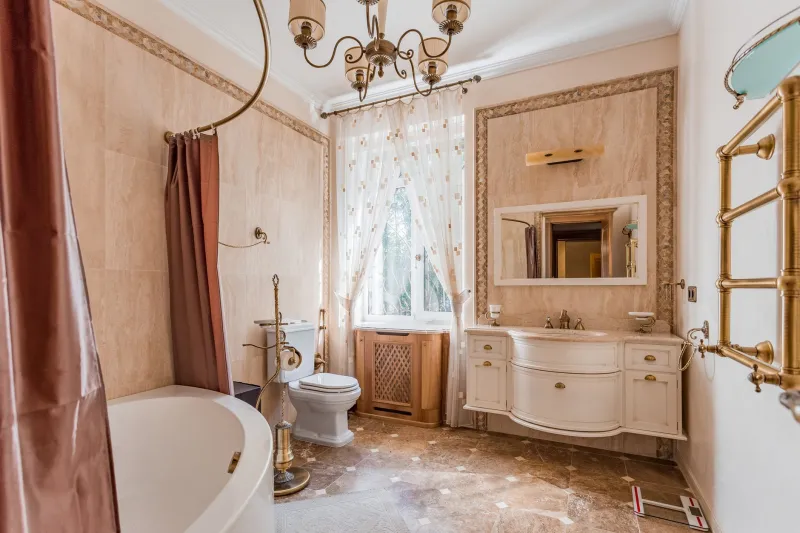
Privacy is the reason many bathrooms acquire a blind in the first place, but it is not the only answer. Café curtains — a short panel covering the lower half of the window — provide screening while leaving the upper glass clear for light. A half-drop curtain works in a similar way. In period homes, where the window may be tall and narrow, this approach can look more at home than a modern roller blind. Obscure glass, if already present, allows a lighter curtain or none at all. The choice should follow the window, the neighbour’s sightline and the amount of daylight the room needs.
Fixing Points for Awkward Rooms
Bathroom windows are often awkward. Sash windows have moving sashes and deep boxes; ensuites may have small windows set high in a tiled wall; cottage bathrooms may have uneven reveals and out-of-square openings. A ceiling-fixed track can carry a curtain across a window without drilling into tile or intruding on a sash box. A recessed track suits a modern ensuite where space is tight. Where a pole is preferred, brackets should be positioned to clear the window furniture and finished in a moisture-resistant material — powder-coated metal or stainless steel rather than untreated wood.
Made-to-measure construction is particularly valuable here. A curtain that follows the drop of an uneven reveal, or that clears a radiator or a towel rail, will perform better than a standard panel. The same applies to the heading: a simple pencil pleat or a shallow wave heading is easy to draw back and does not hold steam in deep folds as readily as a heavily gathered heading.
A Balanced Conclusion
None of this argues that every bathroom should have curtains. A small internal wet room with no window, or a shower room where the window is inside the shower zone, may still be better served by a blind or by no covering at all. But the default deserves scrutiny. In Sussex homes, where period layouts and modern ensuites often sit side by side, a tailored curtain can provide softness, privacy and a more architectural line than a blind — provided the fabric, lining, ventilation and fixing are chosen with the room’s humidity in mind.