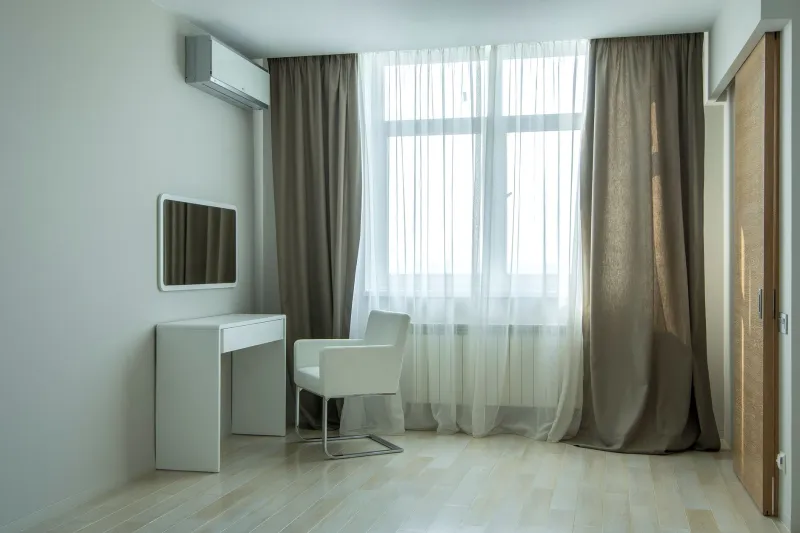
Above the Radiator: Curtain Specifications That Work With the Heat, Not Against It

Photo: SkywalkerPL, CC BY 3.0, via Wikimedia Commons
Walk into almost any period property in Midhurst or the villages around it and the arrangement repeats itself: a sash window, a stretch of wall below the sill, and a radiator bolted neatly into the space between the skirting and the sill. It is an efficient use of a narrow footprint, and it is the reason so many otherwise straightforward curtain commissions begin with a difficult question — how does one hang a generous, floor-skimming curtain without building a tent around the radiator?
The answer is rarely a single compromise. It is a series of small, deliberate decisions about drop, projection, lining and hardware, each of which protects both the appearance of the window and the performance of the heating system.
Understanding what the fabric is actually doing
A radiator works largely by convection. Air warms across its surface, rises, and circulates into the room. Introduce a curtain directly in front of that rising column and the effect is twofold: the fabric intercepts the moving air, and the pocket of warmth sitting between radiator and curtain grows steadily hotter.
The consequences are practical rather than theoretical. A curtain that rests against a radiator will discolour and, over several seasons, become brittle along the contact line. The room itself may feel cooler at seated height while the ceiling stays warm, because the heat has been redirected upward along the reverse of the fabric. And a thermostatic valve shrouded by cloth cannot read the room accurately, which commonly leads to the boiler working harder than it needs to.
None of this argues against curtains. It argues for specification with some care.
Sill length: the honest, workmanlike option
Where the radiator top sits close beneath the sill — a common arrangement in smaller cottage rooms — a sill-length curtain is often the most sensible commission. Hanging the hem ten to fifteen millimetres below the sill, finishing it just above the radiator's top edge, leaves the convection path largely unobstructed and keeps the fabric well clear of the hot surface.
The result is neat and unpretentious, particularly in a room with modest ceiling height. Its drawback is visual: in a tall drawing room, a sill-length curtain can look as though the fabric ran out. Where that is a concern, a compromise of a slightly longer drop finishing just below the radiator's top plate can read as more composed, provided a shelf (see below) is fitted to deflect the rising air forward rather than upward into the cloth.
Full length, properly engineered
A full-length curtain in front of a radiator is not forbidden, but it must be planned rather than inherited. Two conditions matter.
First, the pole or track must project far enough from the wall to clear the radiator's front face by a comfortable margin — 50 millimetres is the barest minimum, and 100 millimetres is preferable where the radiator is deep or the fabric is interlined. Second, the fabric should hang no closer than about 100 millimetres to the radiator at its nearest point, measured with the curtain closed. A curtain that brushes the radiator when drawn has been specified too tight.
Where the radiator protrudes further than the window reveal allows, the usual remedy is a radiator shelf: a simple timber board fitted on brackets above the radiator, projecting perhaps 50 to 75 millimetres beyond its front face. The shelf sends warm air out into the room and acts as a physical separator between heat and fabric. In a period room it also provides a natural place for a lamp, a pair of candlesticks or a small collection of china, and reads as a deliberate piece of joinery rather than a workaround.
Dress curtains and the two-part solution
In rooms where privacy matters but the radiator cannot be moved, a pair of non-functioning dress curtains flanking a Roman or roller blind offers a graceful resolution. The side panels contribute colour, weight and the softening effect of gathered cloth at the window edges, while the blind does the actual work of screening. Nothing obstructs the radiator, and the arrangement often suits Georgian and early Victorian proportions better than a single heavy curtain would.
For working curtains, simple hold-backs or tie-backs are worth considering too. During the heating season the curtains can be drawn back during the day to release the window, then closed at dusk once the radiator has cooled.
Linings, and the question of how much warmth to hold
There is a temptation, when a radiator sits below the window, to reach immediately for the heaviest thermal lining available. It is worth pausing. A thermal lining earns its keep overnight, when the heating is off and the glass is cold; it does not need to be paired with a dense interlining as well. Over-specifying the lining in this situation can produce a stiff, airless curtain that holds warmth against the radiator rather than releasing it into the room.
A well-made thermal lining on a medium-weight face fabric — a linen-cotton union, a closely woven wool blend — is usually the balanced choice. In bedrooms, blackout remains the priority and should be specified on its own terms, with the radiator clearance given extra attention because the curtain will often be closed for long periods.
The small measurements that decide the outcome
Before the workroom begins, four figures should be confirmed on site:
- The height of the radiator's top edge from the floor, not merely the depth of the sill.
- The radiator's projection from the wall, including valves and pipework.
- The position of the thermostatic valve, so that the curtain's stack-back does not smother it. Allow 150 to 200 millimetres of clearance around a TRV; smart valves are particularly sensitive to being blanketed.
- The intended finished drop, checked both with the curtain open and closed.
A curtain that clears the radiator when open and rests against it when closed is a common and avoidable error. The measurement that matters is taken with the fabric drawn across the window.
Finishing touches that keep it looking intentional
A weighted hem prevents the bottom of the curtain from drifting toward the heat source. A wave heading takes up less wall space when stacked than a deep pencil pleat, which helps where the radiator runs close to the window reveal. And a generous return at the leading edge stops light and draughts from slipping through the centre of the window.
Handled this way, the radiator beneath the window ceases to be an obstacle. It becomes part of the brief — a fixed condition that a well-tailored curtain accommodates quietly, without the arrangement ever seeming like a negotiation. If you would like advice on your own window, our workroom is always glad to discuss the details before a single measurement is taken.