A Professional Calm: Dressing the Home Office Window for Screen Work and Video Calls
The home office has become a room with unusually precise demands. It must feel connected to the day outside, yet remain comfortable when the sun is low and bright; it must look presentable on a video call, yet not feel staged; and it must offer privacy in the evening without turning a useful workspace into a closed box. In Midhurst and across Sussex, where spare bedrooms, converted lofts and garden rooms are often pressed into service as studies, made-to-measure curtains offer a measured response to these competing requirements. They are not simply a decorative finish. They are a practical means of managing light, sound and presentation.
Recognising the competing demands of a working window
A desk positioned near a window is usually a pleasure, but it brings a familiar difficulty. Direct sunlight can wash out a laptop screen, while a completely shaded window makes the room feel dim and enclosed by mid-afternoon. The answer is rarely a single heavy curtain pulled across the glass for the whole day. A more considered arrangement allows the occupant to shift between diffuse daylight, filtered brightness and full privacy as the working day progresses.
Video calls add another layer. A window directly behind the desk can turn the occupant into a silhouette, particularly when the camera adjusts for a bright background. A window to the side is often more forgiving, but it may still cast a strong highlight across one side of the face. Curtains can soften that light and provide a calmer background, provided the fabric and heading are chosen with the camera in mind.
Fabric opacity: finding the middle ground
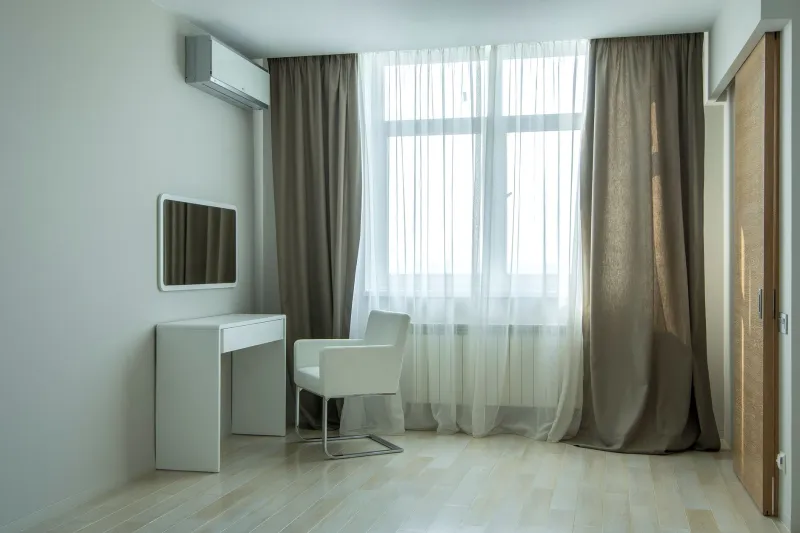
For a home office, the most useful fabrics are those that moderate light rather than eliminate it. A closely woven linen-cotton, a brushed wool blend or a substantial plain weave will filter glare without making the room gloomy. Sheer fabrics are valuable where the window is overlooked or where daylight is precious, but they should generally be part of a layered scheme rather than the only covering.
Pattern deserves careful thought. A large repeat or a bold motif may be attractive in a drawing room, but on a video call it can become distracting and visually restless. Small-scale textures, subtle stripes and tonal weaves tend to read well on camera. Mid-tone colours are often more accommodating than either stark white or very dark shades, since they neither flare under bright light nor absorb all detail in shadow.
Linings that do more than line
The lining is where much of the practical performance of a home office curtain is decided. A standard cotton or polycotton lining improves drape and protects the face fabric from sunlight. A dimout lining reduces the intensity of glare while preserving a sense of daylight. A blackout lining is useful where the room doubles as a guest bedroom or where early summer light disturbs the start of the working day, but it should be combined with a sheer or lighter curtain if the room is to remain usable in daytime.
Interlining, a softer layer between face fabric and lining, adds body and helps to mute sound. In a garden room or a room close to a road, this can make the space feel more settled. Thermal linings are also worth considering in converted or older rooms, where they can reduce draughts and help stabilise temperature without altering the appearance of the window.
Headings and the question of adjustability
A home office curtain is handled more often than a drawing room curtain. It may be opened in the morning, partly closed against glare at noon and drawn fully in the evening. A heading that stacks neatly and slides easily is therefore a practical asset. Hand-pleated headings, French pleats and wave headings all offer a formal, orderly appearance, while pencil pleat remains a straightforward option where the window is not especially wide.
Fullness should be sufficient to allow the curtains to close without stretching flat, but not so generous that the stack overwhelms a small room. A ceiling-mounted track can be particularly effective in a home office, since it allows the curtains to run clear of the desk and creates an impression of height. Where a radiator or sill restricts the drop, a shorter curtain or a sill-length pair may be more appropriate than a full-length arrangement that cannot hang freely.
Positioning the desk and the curtain
If the layout allows, place the desk so that the window is to one side rather than directly behind the chair. This reduces silhouette effects on video calls and gives the occupant a view without staring into the light. The curtain should be able to close past the desk edge without catching on equipment or paperwork. A track that extends beyond the window recess will allow the curtains to be drawn clear of the glass, admitting more daylight when full privacy is not needed.
In a narrow spare room, a single curtain on one side may be preferable to a pair that crowds the desk. In a garden room, a layered scheme with a sheer and a heavier curtain can be especially effective, giving the occupant control over glare while retaining a connection to the garden.
Privacy through the working day
Privacy requirements change from morning to evening. A sheer curtain can obscure the view from outside during daylight hours while still allowing light into the room. By evening, when interior lighting makes the room more visible, the main curtain can be drawn. This layered approach is more flexible than relying on one fabric to do everything, and it suits the pattern of a working day in which the room may be used for calls, concentration and, later, quiet reading.
For Sussex homeowners adapting a spare room or garden room, the most successful home office curtains are those that feel calm, tailored and easy to live with. The aim is not to shut the day out, but to place it under gentle control: enough light to work by, enough filtering to keep screens readable and enough composure to make a video call feel professional without feeling impersonal.