Pattern Harmony Across a Room: Aligning Repeats on Multi-Window Curtain Schemes

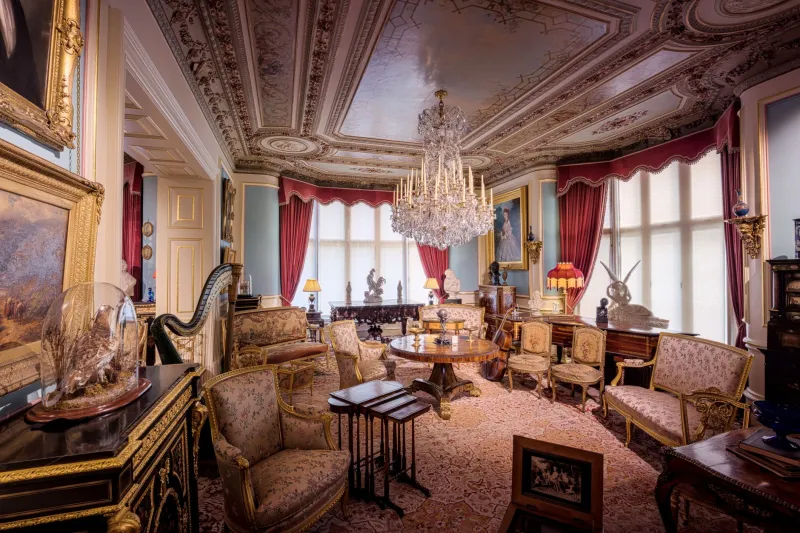
Photo: Anonymous (Sephardic workshop), Public domain, via Wikimedia Commons
A sitting room with two front windows and a bay, or a bedroom with a principal window and a narrow sidelight, presents one of the more absorbing briefs in curtain making. The fabric has been chosen, the heading agreed, and then comes the question that decides whether the finished room feels composed or quietly unsettled: how do you persuade a pattern to behave identically on windows that are not identical?
The answer is neither mysterious nor especially difficult, but it does require decisions to be taken early, before cloth is cut. What follows is a plain-English account of the mechanics, written for Sussex homeowners who would rather understand the reasoning than simply accept a quotation.
The repeat is the ruler, not the window
Every patterned fabric is built on a repeat: the vertical distance before the design begins again. A modest floral might repeat every 32cm; a large damask or a trailing leaf could run to 64cm or beyond. That figure, not the window's height, governs how much cloth each drop requires.
What matters for a multi-window room is that the repeat becomes a shared unit of measurement. Once the maker knows the repeat, every decision — how much fabric to order, where the motif will sit at the hem, whether two windows can be brought into step — follows from it.
Straight match, half drop and what the label tells you
Most furnishing fabrics are printed or woven with a straight match, meaning motifs sit level across adjacent widths. Others use a half drop, where the design steps down by half a repeat from one width to the next. Half drops are handsome but hungry: they effectively add half a repeat to the allowance for every alternate width, and they make cross-window alignment noticeably harder to achieve.
A third category, railroaded fabric, runs the pattern across the width rather than up it, which can eliminate joining altogether on wide windows. It is worth asking whether a favoured design is available railroaded, particularly for a bay where joins are conspicuous.
Doing the arithmetic before the order goes in
Take a typical Midhurst sitting room with a finished drop of 210cm from pole to floor. Add 15cm for heading and hem allowances, giving 225cm per drop. On a fabric with a 64cm repeat, each drop must be cut in whole repeats: four repeats yield 256cm, so 31cm of every drop is sacrificed to the pattern.
That wastage is not an error; it is the cost of matching. Across a room with, say, twelve drops, the difference between a small repeat and a large one can amount to several metres of cloth. This is why a maker will ask for the repeat before quoting, and why two fabrics of similar appearance can carry quite different total costs.
Horizontal matching adds a further consideration. Each curtain panel is normally cut so the pattern aligns at the leading edges when the curtains are drawn, and so the motif sits symmetrically on the pair. When the same fabric is used on three or four windows, the maker must decide whether panels from different windows should also align with one another.
Choose an anchor window and work outwards
In any room, one window is seen first — usually the largest, the one opposite the door, or the one the morning light favours. Treat it as the anchor. Set the pattern on that window so the motif sits pleasingly relative to the pole and the hem, then apply the same vertical offset to the others.
This produces the effect the eye actually reads: a consistent band of pattern at a consistent height across the room. Absolute mathematical correspondence between every motif on every window is rarely achievable and seldom necessary.
When the windows are not the same height
Period Sussex houses are full of near-misses: two windows that differ by 8cm because the floor slopes, or a bay whose centre light sits lower than its flanks. There are two defensible approaches.
- Match the hem, not the top. Hanging all curtains to a common floor line conceals modest differences in window height and is usually the calmer choice in a traditional room.
- Match the pattern to the pole. If the pattern placement is the dominant visual feature, aligning motifs to each pole line will read as deliberate, even where hems vary slightly.
What almost never works is a half-measure: hems aligned but pattern offsets left unconsidered, which produces a room that looks almost right, and therefore worse than either.
Radiators, sills and the consistent hem
A radiator beneath one window and not another is a common complication. Shortening one pair to sill level while leaving the other full length will break the pattern's vertical continuity entirely. Where the radiator must be cleared, consider a sill-length treatment throughout the room, or a full-length curtain hung to clear the radiator with the pattern set to a consistent height. The latter often preserves the scheme better than mixing lengths.
Bays, returns and side windows
A bay with two narrow returns is where alignment ambitions most often need tempering. The returns may be only 40cm wide, insufficient to accommodate a full motif. Rather than forcing a large design onto a small panel, the usual solution is to centre the motif on the main lights and allow the returns to carry whatever portion of the design falls naturally, provided the fabric is cut from the same position in the repeat as its neighbour.
Where a bay is paired with a separate side window, as in many Midhurst and Petworth terraces, check that both treatments are cut from the same batch of fabric. Dye lots vary, and a match that looks perfect in the workroom can look uneven once daylight reaches it.
Sometimes difference is the better answer
There are rooms where forcing a match looks strained. A narrow sidelight beside a broad sash may be better dressed in a plain coordinate drawn from the pattern's ground colour, or in the same design at a smaller scale. This is not a concession but a design decision, and it frequently looks more assured than a pattern squeezed into a space that cannot carry it.
The test is simple: if a visitor would notice the mismatch, resolve it; if they would only notice it after being told, the room will survive it comfortably.
What to hand your curtain maker
To brief this properly, supply the fabric name and colourway, the repeat and match type, the batch or dye-lot number, the finished drop for each window, the pole or track positions, and a note of which window you consider the anchor. Photographs of the room from the doorway are valuable, as they show what the eye sees first.
Pattern matching across several windows is ultimately a matter of deciding, in advance, which compromises are acceptable and which are not. Settled at the outset, they cost nothing but a conversation. Settled after the cloth is cut, they cost rather more.