The Unseen Skeleton: Choosing Poles and Tracks for Sussex Windows
Curtain fabric tends to receive the attention. Hardware is often left until the final stages, when the making is complete and the fitting date is close. That sequence is understandable, but it is not always wise. A pole or track is the skeleton of a made-to-measure curtain: it carries the weight, governs the movement and establishes the line at the top of the window. In a Sussex home, where a fifteenth-century cottage, a Georgian townhouse and a contemporary extension may all sit within a few miles of one another, the right answer is rarely universal.
Begin with the window, not the showroom
The first decision is not decorative. It is structural. Before comparing finials or finishes, consider the age and construction of the wall or ceiling, the shape of the window, the weight of the intended curtain and the way the room is used. A slender pole fixed to a solid brick wall above a cottage window presents a different set of requirements from a recessed track set into the ceiling of a modern glazed extension.
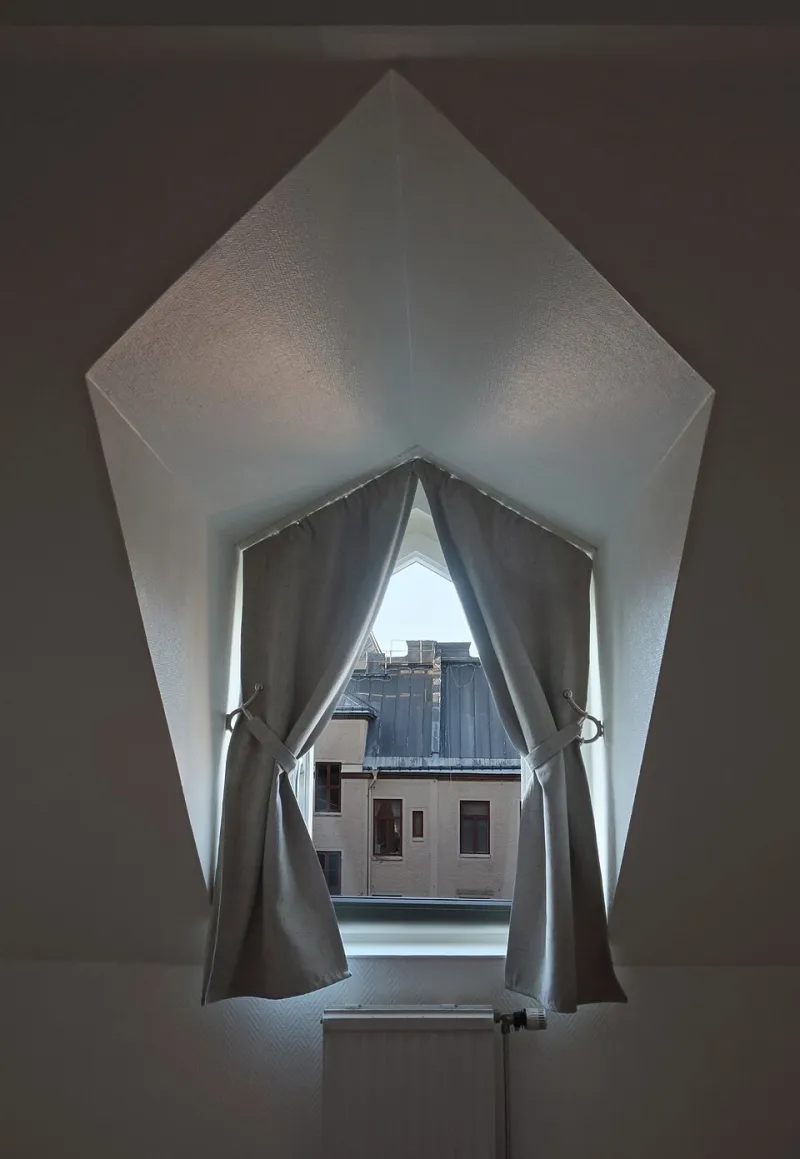
Bay windows deserve particular attention. A pole that follows every angle can become fussy, while a well-planned track may allow the curtains to draw smoothly around the curve. For sash windows in period properties, wall-mounted hardware often preserves the visible frame; for full-height windows in newer homes, a ceiling-fixed track can create a cleaner, more architectural result. The hardware should answer the window rather than compete with it.
Poles: visible structure and quiet character
A curtain pole is both support and ornament. In a reception room with generous ceiling height, a substantial pole can provide a deliberate horizontal line and make the curtains appear more generous. In a smaller bedroom or a low-ceilinged cottage, a slender pole may be more appropriate, particularly where the window surround is already busy with beams or mouldings.
Material choice matters. Metal poles are available in brass, bronze, steel and aluminium, with finishes ranging from polished and lacquered to aged and brushed. Wooden poles offer warmth and can be painted to match joinery or left with a visible grain. For heavier interlined curtains, the pole diameter and bracket spacing must be calculated properly; a decorative pole that is visually right but structurally marginal will eventually sag or strain at its fixings.
Finials are optional in the functional sense, but they complete the composition. A simple ball or disc finial suits a restrained interior, while a more decorative end should be chosen with care in rooms where other details are already ornate. The aim is coherence, not accumulation.
Tracks: discretion and smooth operation
Tracks are often selected where appearance should recede. A wall-mounted track can sit close to the ceiling and conceal its mechanism behind the curtain heading; a recessed track can disappear entirely into a ceiling void, leaving only the curtain visible. The latter is particularly effective in modern rooms and in extensions where a continuous ceiling line is part of the design.
Operation is the practical advantage. Corded tracks can be useful for tall windows or heavy curtains, although cord safety and child safety must be considered carefully. Hand-operated tracks with well-chosen gliders are often quieter and simpler. For bay windows, a track can be bent to follow the geometry of the opening, allowing the curtains to stack neatly at each side rather than interrupting the view.
The track itself should be specified with the curtain in mind. A lightweight track intended for sheers is not suitable for heavy interlined drapes. The number of brackets, the quality of the runners and the method of joining sections all affect long-term performance. These are unglamorous details, but they are the ones that determine whether the curtains still draw smoothly in ten years' time.
Materials, finishes and the Sussex interior
In period properties around Midhurst and the surrounding villages, hardware often works best when it respects the scale and patina of the building. Aged brass or painted wood may sit more comfortably against old timber and lime-washed walls than a highly polished contemporary finish. In a modern house, powder-coated aluminium or a recessed track may be the more natural choice, particularly where the palette is cool and the detailing is minimal.
Finish should be considered alongside the fabric. A dark pole can frame a pale curtain and sharpen the window opening; a pale pole can recede and allow the fabric to dominate. In rooms with little natural light, a reflective metal may introduce a useful gleam, but it can also draw attention to the hardware. There is no fixed rule, only the question of what the room needs.
Fixing matters as much as appearance
Sussex has a wide range of building fabrics: timber-framed cottages, brick and flint walls, rendered elevations, stone and modern lightweight blockwork. Each demands a different fixing approach. Into solid masonry, appropriate plugs and screws can provide secure support. Into timber, the fixing must engage sufficient sound timber rather than crumbling historic material. Into plasterboard or proprietary insulated systems, specialist fixings or additional battens may be required.
This is not a stage to leave to guesswork. The combined weight of a long pole, heavy curtains and repeated opening and closing is considerable. Where a ceiling track is planned, the ceiling structure should be checked before the track is ordered. In listed or historic buildings, fixing methods should be reversible and should avoid unnecessary damage to original fabric. A made-to-measure curtain deserves a fixing that is equally considered.
A final check before ordering
Before committing to hardware, confirm the full drop, the intended stack-back position and the clearance needed for radiators, window handles and skirting. Check that the curtain will not foul a sill or a window opening. Consider how the curtains will be cleaned and whether the heading can be removed without dismantling the entire system. Choose a finish that relates to the room's existing metals and joinery without matching them slavishly.
Hardware is rarely the first thing a visitor notices, and that is often the point. When a pole or track is well chosen, it allows the curtains to do their work: to soften light, temper draughts, frame a view and bring a room to completion. In 2026, with fabric ranges broader than ever, it is worth remembering that the quietest element in the scheme may be the one holding everything together.