Safe by Design, Dark by Night: Curtains for Sussex Nurseries and Children's Rooms

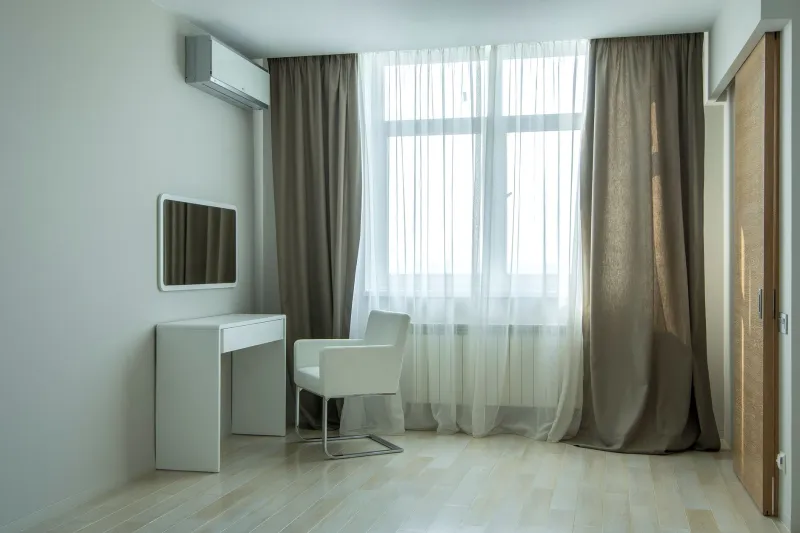
Photo: child safe blackout curtains nursery window made to measure neutral fabric, via cdn.pixabay.com
Children's rooms ask a great deal of a window dressing. The curtains must darken the room for daytime naps and long summer evenings, soften sound and draughts, withstand sticky fingers and occasional washing, and — above all — remove any obvious hazard from a small person's reach. In Sussex homes, where nurseries are often carved out of compact cottage rooms, dormer conversions or period attics, the challenge is compounded by windows that are irregular in shape, shallow in reveal or awkwardly placed. Off-the-peg blackout panels rarely rise to the occasion. A made-to-measure approach allows safety, darkness and comfort to be specified deliberately rather than hoped for.
Safety Is a Specification, Not an Accessory
The most important decision in a child's room is not the colour of the cloth but the way the curtain is operated and secured. Looped cords, dangling chains and low-level tiebacks are the obvious concerns. Current UK guidance on window dressings is clear that cords and chains should be kept out of reach, preferably by eliminating them altogether. For curtains, that means looking beyond the heading itself to the track, the wand, the tieback and the cleat.
Cordless and cleat-free systems are the simplest route. A wand-operated track, a spring-assisted roller-style mechanism or a motorised track removes the pull cord entirely. Where a traditional curtain track is preferred, specify a hand-operated baton rather than a cord loop. Tiebacks should be avoided in very young children's rooms; if they are used, they should be fixed well above the child's reach and never left with a loose cord. Cleats, where specified for older children, should be mounted high — commonly at least 1.5 metres from the floor — and kept free of excess cord.
Heading choice matters too. Pencil pleat and gathered headings rely on cords to draw up the fabric; these can be secured and shortened at installation, but a hand-pleated or fixed-wave heading removes the issue altogether. The curtain should also be installed so that it cannot be pulled down easily: robust brackets, suitable fixings for the wall or ceiling, and a track or pole rated for the weight of the lined fabric.
Building Blackout Without the Bulk
Genuine blackout in a nursery is not simply a matter of buying the darkest fabric available. Many inexpensive blackout panels use heavy, coated cloth that feels stiff, traps moisture and can make a small room stuffy. A better solution is usually a breathable face fabric paired with a dedicated blackout lining. The lining does the work of excluding light; the face fabric contributes colour, texture and a more comfortable hand.
For Sussex bedrooms that are chilly in winter and warm in summer, a blackout lining with a degree of thermal performance is worth considering. A separate interlining can add softness and insulation without turning the curtain into a rigid barrier. The aim is a layered construction: face fabric, blackout lining and, where appropriate, a lightweight interlining. This gives darkness and warmth while allowing the window to breathe.
Light control is only as good as its edges. Even a perfect blackout lining will leak light around the sides and top if the curtain does not overlap the window sufficiently. Specify generous returns to the wall, a track that extends beyond the window reveal, and an overlap in the centre where two curtains meet. In dormer and attic rooms, a ceiling-fixed track or a slim pelmet can close the gap between curtain and ceiling. These details are difficult to add to a standard pair of ready-made curtains, which is one reason bespoke work is so often the more practical answer.
Small Windows, Period Frames and the Off-the-Peg Problem
Midhurst and the surrounding villages contain a high proportion of period cottages, converted barns and houses with dormer windows. Such windows are rarely a standard width or drop. Ready-made curtains are sold in a limited range of sizes, so they tend either to puddle on the floor or finish short of the sill; they may also be too narrow to close properly over a period frame. Blackout is especially unforgiving of poor fit, because every gap becomes visible as a bright line.
Made-to-measure curtains can be cut to the exact drop, including the uneven floors and sloping ceilings often found in older Sussex homes. They can be shaped around a dormer reveal or hung from a track that follows the line of a bay. For awkward windows, a fitted pelmet or a ceiling-mounted track can make a substantial difference to both darkness and draught exclusion. The same principle applies to thermal comfort: a curtain that sits close to the window and overlaps at the edges will perform far better than a loose panel that hangs away from the frame.
Practicality That Survives Childhood
Children's rooms are not showrooms. Curtains will be brushed against, sat beneath, used to build dens and occasionally washed. Fabric choice should reflect that reality. Look for face fabrics that are washable or wipe-clean, and ask how the lining should be cleaned. Some natural fibres and many synthetic blends respond well to gentle machine washing; others are better dry-cleaned. A reputable workroom will be able to advise on the care code and on whether the finished curtain can be washed without losing its shape.
Design should also allow for growth. Character prints and very pale fabrics may suit a nursery but date quickly. A calm, neutral or softly patterned fabric in a classic heading will move with a child from cot to bed and from toddler to teenager. If a stronger colour is wanted, it can be introduced through bedding, artwork or a removable valance rather than committing the whole window to a theme.
A Parent's Checklist for Made-to-Measure Curtains
- Measure the window accurately, including the full drop to the floor or sill and any obstructions such as radiators or window handles.
- Choose a cordless, wand-operated or motorised system wherever possible; if cords are unavoidable, specify high-level cleats and cord tidies.
- Avoid looped tiebacks and dangling chains in very young children's rooms.
- Specify a dedicated blackout lining rather than relying on a heavy coated face fabric.
- Ask about thermal lining or interlining if the room is draughty or north-facing.
- Plan for overlap and returns so that light does not leak at the edges.
- Confirm the cleaning method for both face fabric and lining before ordering.
- Choose a heading that can be securely fixed and will not encourage pulling.
- Allow for future changes in décor by keeping the colour scheme adaptable.
- Use a professional installer to fix tracks and poles securely into the wall or ceiling.
Well-specified curtains do more than make a room look finished. In a child's bedroom they contribute to sleep, warmth and peace of mind. For Sussex parents, the route to that outcome is a measured, safety-led approach — one that treats the window as a piece of joinery to be solved, not simply a space to be decorated.