Hushing the House: The Acoustic Case for Tailored Curtains in Sussex Homes

Photo: heavy interlined made to measure curtains in a Sussex period sitting room window, via cdn.firstcry.com
In a county of timber-framed cottages, Edwardian villas and contemporary open-plan conversions, sound behaves in remarkably different ways. A high-ceilinged reception room in Midhurst may carry echo long after a conversation has ended, while a modern kitchen-dining extension can amplify the clatter of daily life. Road noise from a nearby lane, the hum of a home office and the general bustle of a busy household all compete for attention. Made-to-measure curtains are rarely specified with acoustics as the first consideration, yet the right design can make a meaningful difference to how a room feels and sounds.
Why soft furnishings change what we hear
Sound travels through the air and strikes surfaces. Hard materials such as plaster, glass, stone and timber reflect it, which is why an empty room often sounds hollow. Soft furnishings absorb a proportion of that energy, particularly in the middle and higher frequencies. Curtains are especially useful because they introduce a large, pleated surface area into a room without occupying floor space.
The effect is not merely decorative. A generous curtain can reduce flutter echo between parallel walls and take the sharpness out of footsteps, crockery and conversation. It will not turn a busy road into a country lane, but it can make a room feel calmer and less fatiguing. That distinction matters when specifying curtains for homes where comfort, concentration or rest are priorities.
Weight, interlining and the value of density
Acoustic performance in curtaining is closely linked to mass. A lightweight cotton voile will filter daylight beautifully but will do little to hush a room. Heavier fabrics such as wool, velvet, chenille and densely woven cottons provide more resistance to sound energy. For rooms where noise is a genuine concern, an interlined curtain is often the most effective specification.
Interlining sits between the face fabric and the lining. It adds body, improves drape and increases the overall density of the curtain. In practical terms, this means a fuller, more substantial window dressing that absorbs more sound and reduces the tendency for noise to pass through gaps and folds. A separate lining also protects the face fabric and helps with insulation, so the acoustic benefit sits alongside other domestic advantages.
It is important, however, not to assume that the heaviest available fabric is always the correct answer. A modest bedroom window may benefit from a well-interlined wool or velvet, while a large garden room might need a different balance of weight, light control and visual warmth. Fabric samples should be assessed in the room itself, not only in a showroom.
Fullness, pleats and coverage
A curtain only performs as well as its making allows. Deep pleats and generous fullness create more fabric surface and more folds for sound to encounter. A skimpy curtain stretched across a window may look neat, but it offers little acoustic benefit. Floor-length curtains that return to the wall at each side are generally more effective than short curtains that stop at the sill, because they cover more of the window reveal and reduce the routes by which sound can escape.
Coverage matters at the edges as well as the centre. Gaps at the sides, a poorly overlapped pair of curtains or a track that stops short of the wall can undermine the effort invested in the fabric. Where privacy and noise are both concerns, a ceiling-fixed track or a pelmet can help to close the gap between curtain and ceiling and create a more continuous barrier.
Room-by-room considerations
In a home office, the aim is usually to reduce distraction rather than to create a recording studio. Interlined curtains can soften the click of a keyboard, the ring of a telephone and the general hum of a house. They also improve the visual comfort of a room used for concentrated work.
In bedrooms, curtains are often expected to address early morning traffic and neighbourly noise. Heavier fabrics and full-height coverage can take the edge off such sounds, but low-frequency engine noise is a different matter. If the problem is persistent, curtaining should be considered part of a wider strategy that may include glazing improvements or building works.
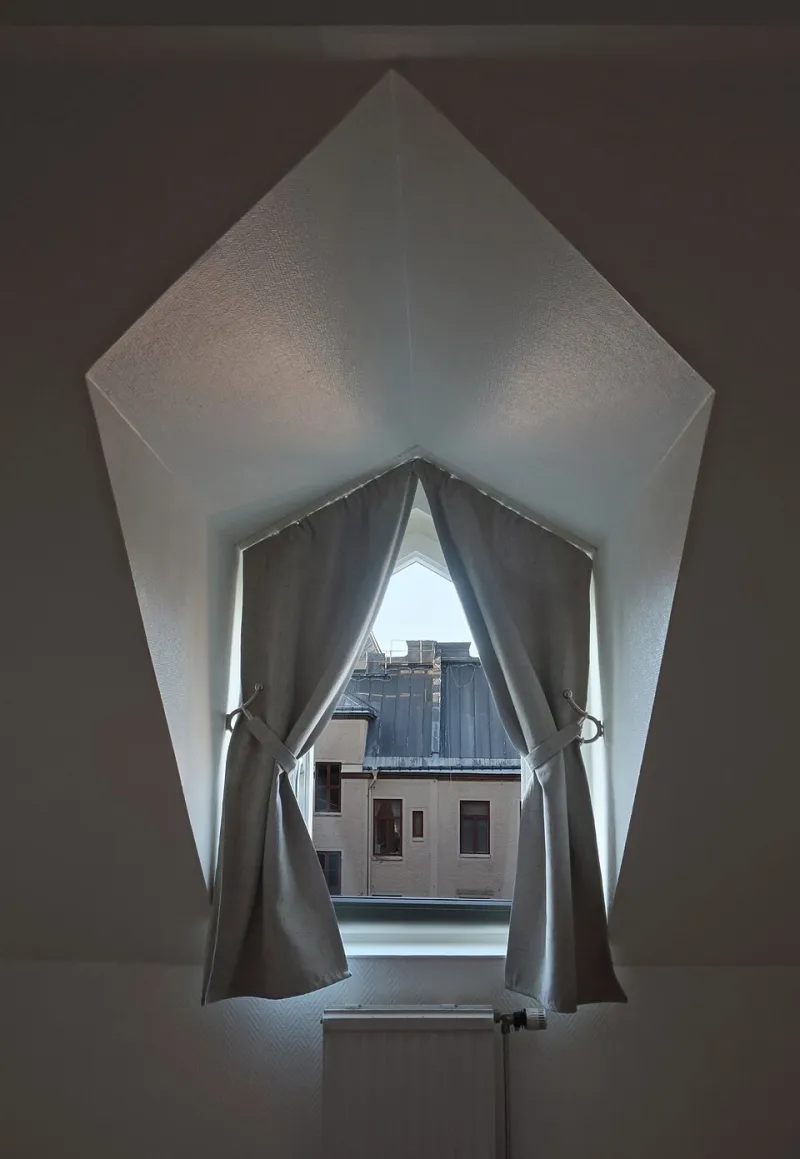
Open-plan living spaces present a particular challenge. Hard floors, large glazed doors and wide expanses of wall can create a lively acoustic environment. Curtains at the principal windows, together with other soft furnishings, can help to settle the room. In period properties, where windows may be irregular and walls less than straight, made-to-measure curtains are especially valuable because they can be shaped to the opening rather than forced into a standard size.
What curtains can and cannot do
It is worth being clear about the limits. Curtains are not soundproofing. They reduce reverberation within a room and can slightly attenuate sound passing through a window, but they will not eliminate noise from a main road or a railway line. Claims of dramatic decibel reduction should be treated with caution. The honest expectation is a quieter, softer room with less echo and a less abrasive quality to everyday sound.
This is particularly relevant in Sussex homes where older windows may be single-glazed or where converted spaces have introduced new acoustic weaknesses. Curtaining can complement other measures, but it should not be sold as a substitute for them. A measured, realistic approach is more useful than an overpromise.
The fitting details that make the difference
Professional fitting is where much of the acoustic benefit is either realised or lost. A made-to-measure curtain needs a track or pole that is securely fixed and correctly positioned. Returns to the wall, generous overlap in the centre and a clean meeting of curtain and ceiling all help to reduce gaps. The stacking space must also be calculated properly so that the curtains can be drawn clear of the glass without being compressed.
For rooms where noise is a priority, it is worth discussing the fixing method at the measuring stage. A ceiling-mounted track, a discreet pelmet or a deeper return may be appropriate. These are not merely aesthetic choices; they determine how effectively the curtain performs as a soft barrier.
A considered approach
Acoustic comfort is rarely the only reason to commission bespoke curtains, but it is a sensible consideration in busy homes. Weight, interlining, fullness and fitting all contribute to the result, and each can be tailored to the room rather than chosen from a standard range. For homeowners in and around Midhurst, the most successful schemes are those that balance fabric, function and the character of the building. The result is a quieter room, a softer atmosphere and curtains that earn their place on more than appearance alone.