When the Window Refuses to Conform: Tailored Curtain Solutions for Period and Rural Sussex Homes
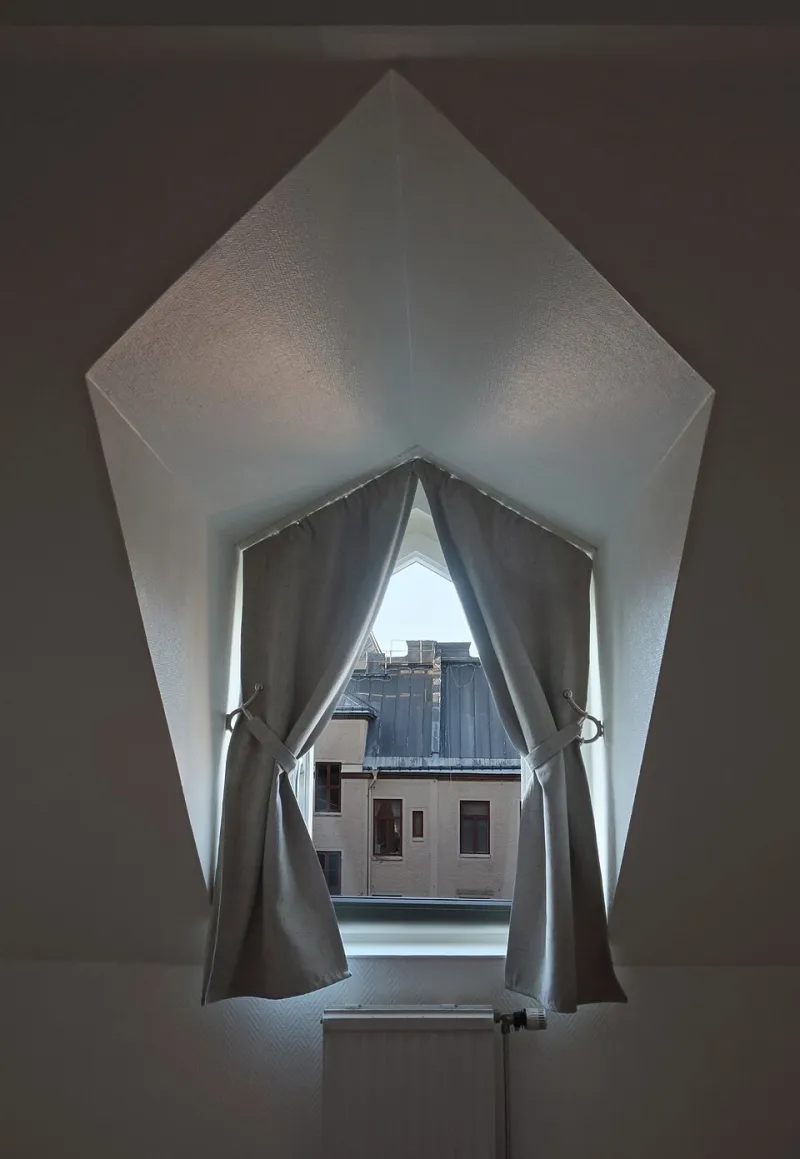
Photo: W.carter, CC BY-SA 4.0, via Wikimedia Commons
Sussex has no shortage of windows that decline to follow the standard pattern. A dormer tucked into a sloping roof, an arched opening in a Georgian wall, or a cottage window set deep into a thick reveal can defeat a conventional curtain pole and leave a room feeling unresolved. The answer is rarely to force the window into a standard template. It is to design the curtain around the geometry, using made-to-measure making and appropriate hardware.
Dormer windows: working with the slope
Dormer windows introduce two difficulties: a sloping ceiling and a reduced amount of space above the window. A wall-mounted pole is often impossible or visually clumsy. The more successful solution is usually a ceiling-fixed track, set back from the window line so that the curtain can hang clear of the reveal. A slim-profile track can be recessed into the ceiling or mounted directly, and the curtain can be made to a shorter drop that finishes neatly at the sill or just below it.
Fabric choice matters here. A lightweight to medium-weight linen blend or a soft wool will gather into the confined space without creating an oppressive block of colour. Large pattern repeats should be treated with caution on a short drop, where the design may be truncated. A simple lining or a light interlining will improve privacy and soften the acoustics without adding unnecessary bulk.
Arched openings: following the curve
An arch is a feature, not a problem to be hidden. Curtains for an arched opening can be made to follow the curve through a shaped heading and a bendable track, or they can be hung as fixed panels that frame the arch rather than close across it. The choice depends on whether the arch needs to be covered for privacy and warmth or simply dressed for effect.
For a working curtain, a ceiling-mounted curved track is often the most practical route. The track should be specified by template rather than estimated, because the radius and the spring of the arch affect how the curtain falls. A fluid fabric — a fine linen, a lightweight wool or a soft silk blend — will follow the curve more gracefully than a stiff, heavily interlined cloth. If the arch is to remain visible, a pair of narrow side panels can provide colour and softness without interrupting the architecture.
Deep cottage reveals: using the recess
Cottage windows are frequently set into thick walls, leaving a deep reveal that can be an asset. Rather than face-fixing a pole across the wall and losing the character of the recess, consider fitting the curtain inside the reveal on a recessed track. This keeps the window arrangement compact and allows the curtain to sit close to the glass, which can improve insulation. Where the reveal is very deep, a face-fixed track with extended brackets may be preferable, but it should be set far enough forward to allow the curtain to clear the wall.
In a cottage nook or window seat, the curtain should not compete with the joinery. A simple heading, a calm fabric and a neat sill-length drop will often be more successful than a full-length curtain that swamps the space. Made-to-measure making allows the drop to be set precisely to the window seat or sill, avoiding the pooled hem that can look untidy in a small room.
Hardware and fitting considerations
Awkward windows place greater demands on hardware. Ceiling-fixed tracks, bendable tracks, recessed channels and extension brackets all have a role, and the fixing must be chosen for the wall or ceiling material as well as the curtain weight. In older Sussex properties, ceilings and walls can be uneven, so a site survey is essential. The curtain should also be designed with a clear stack: where the curtain sits when open, and whether it obstructs a window handle, a radiator or a piece of furniture.
Fabric choices that flatter awkward shapes
For dormers and deep recesses, medium-weight fabrics with a soft handle are generally the most forgiving. They hold a fold without stiffness and can be lined for privacy. For arched openings, fluidity is more important than weight. Small-scale patterns and tonal textures tend to work better than large repeats on short or unusually shaped drops. Above all, the fabric should be chosen after the window has been assessed, not before; the geometry should lead the specification.
Turning the awkward into the architectural
The most successful treatments for difficult windows are those that accept the shape rather than disguise it. A dormer curtain that follows the slope, an arched curtain that repeats the curve, or a cottage curtain that sits quietly within its reveal can make a room feel finished. For homeowners in Midhurst and across Sussex, the value of made-to-measure lies not only in fit but in judgement: knowing when to simplify, when to follow the line of the building, and when to let the window remain the feature.