The View Has a Veto: Curtain Decisions for Garden-Facing Windows in Midhurst
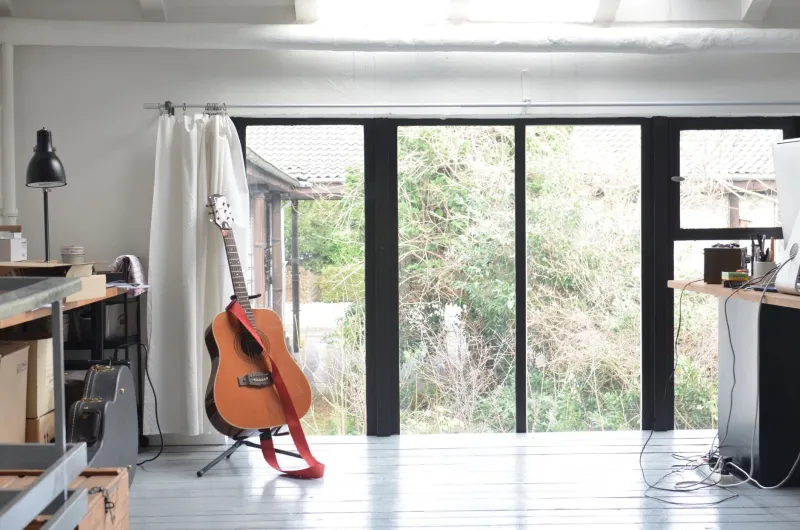
In a corner of West Sussex where gardens run to old brick walls, hedgerows and long lawns, the window is frequently the finest picture in the house. The instinct to dress such a window generously is understandable, and often correct. Yet a curtain can just as easily become a shutter. The work lies in deciding, deliberately, what the garden should be permitted to do: lead the composition, share it, or step discreetly back as the light fades.
Begin with the window's job description
Not every garden-facing window performs the same task. A sitting room window is looked through for long stretches of an afternoon; a bedroom window is chiefly looked out of at waking and closing. A kitchen window above a sink is a working window, viewed at close range, while a landing window may serve almost entirely as borrowed light. Establish this hierarchy before any fabric is considered.
The same reasoning applies to the privacy gradient. A ground-floor window close to a footpath, lane or neighbouring drive will want a daytime filter of some kind. A first-floor window above a mature hedge or a wall may need very little at all. Answering these questions honestly at the outset prevents the common outcome in which a homeowner, anxious about being overlooked, specifies a heavy curtain that is never opened properly again.
Sheer layers: a filter rather than a covering
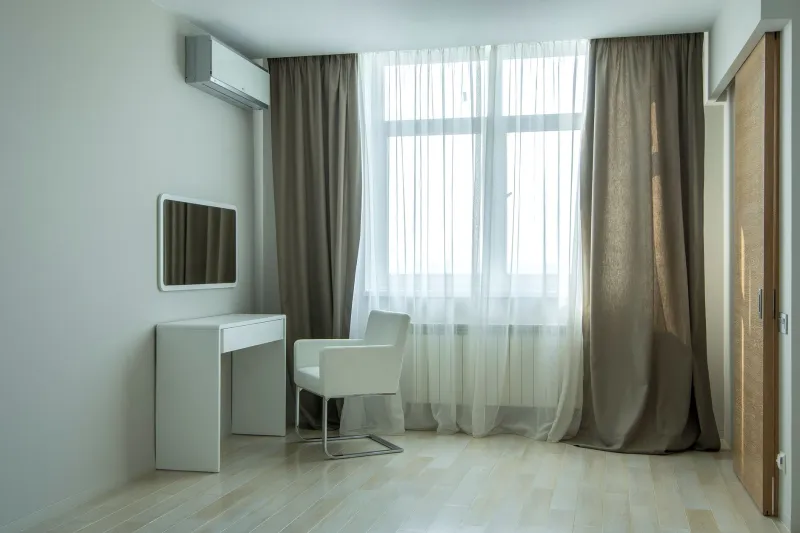
The most useful device for a garden view is the sheer. A fine voile, a loosely woven linen or a light cotton, hung close to the glass on its own slim track and drawn across by day, does something a heavier curtain cannot: it preserves the garden as a legible presence — shapes, greens, weather, the movement of branches — while reducing the room behind it to a soft wash.
Natural fibres serve this purpose best. High-sheen synthetics catch light and read as a screen; a linen-mix sheer with a little slub in the weave reads as part of the landscape. Keep the heading simple, whether a fine gathered wave or a pared-back rod pocket, and keep the drop short of the floor if the sheer is only ever a daytime layer. Where privacy is a genuine rather than imagined concern, a sheer plus a separate lined curtain on a double track gives the most control: filtered by day, closed properly at night.
Split draws and the discipline of stack-back
The single greatest destroyer of a view is a curtain parked in the middle of it. On any window of real width, specify a split draw so that the curtains part from the centre and gather at the outer edges. The specification matters as much as the principle. Ask how much wall the curtains will occupy when fully open, and check that this stack lands on a pier, a wall return or a section of plain wall rather than across the glazing itself.
Where interior wall space is short, the track can be extended beyond the window reveal so that the fabric stacks clear of the glass entirely. This is a small detail with a large effect, and it is one of the quiet advantages of a made-to-measure approach over an off-the-shelf pole. On very wide openings, a two-way draw with a generous overlap at the centre prevents the light leak that would otherwise appear exactly where the garden is most visible.
Heading depth and the height of the top line
The heading governs where the eye begins, and therefore how much of the view survives. A deep pinch pleat or goblet heading introduces a band of fabric across the top of the window, which on a low-ceilinged room or a tall glazed door can crop the top of the garden considerably. On a picture window, a shallower heading, or a track concealed within a ceiling recess, keeps the top line high and the view unclipped.
As a rule, the top line should sit as high as the architecture reasonably permits — at the ceiling, at the underside of a cornice, or at the top of the reveal — and never at the top of the glass unless there is a specific reason. The same reasoning counsels caution with pelmets and valances on garden elevations: they can be handsome, but they take a horizontal slice of view in exchange.
Fabric density and how much garden to admit
Opacity is a spectrum rather than a choice between two extremes. A heavy interlined wool sits at one end; a fine cotton with a standard lining in the middle; an unlined linen near the other. For most living rooms facing a garden, a lined but not interlined curtain offers the best balance: enough body to drape cleanly, enough weight to hang well, but not so much bulk that the window feels padded.
Weave matters as much as weight. A tight, dense cloth will read as a solid plane even in daylight, whereas a looser weave with a little texture holds colour and shadow without closing the view down. Sample the fabric at the glass, in morning light and again at dusk, before committing. Where the view is the point of the room, consider a separate blind for night-time privacy and keep the curtains light enough to be drawn back fully during the day.
Garden doors and the threshold
French, patio and bifold doors present a different problem, because the curtain must coexist with a moving panel. A curtain across a frequently used door needs floor clearance, a track that will not foul the door furniture, and a leading edge that can be hooked back out of the way. Where the door is in constant use, a well-fitted roman or roller blind is often the more honest solution, with full-length curtains reserved for the flanking windows.
For a door used occasionally, however, full-length curtains on a recessed track read handsomely and soften the transition between room and garden. Allow ten to fifteen millimetres of clearance above a threshold, more above a rug, and check that the leading edge clears the door handle through its full swing.
Picture windows and wide glazing
Wide glazing is the most demanding case. The span calls for greater fullness to drape properly, yet too much fabric turns into a wall of cloth. Keep the stack tight, choose a fabric with a fluid handle rather than a stiff one, and let the width of the view be answered by a single broad sweep rather than a series of fussy pleats.
A short sequence before ordering
Decide the daytime privacy requirement first; measure the stack, not merely the window; fix the top line height; sample the fabric at the glass in two lights; and specify the track before the fabric. A garden is not a backdrop to be managed but the reason the room was built as it was. The best curtain for such a window is the one that knows when to be present, and when to step aside.